Why Objection Detection Must Come Before Everything Else
The most important rule in hotel SDR call coaching is this: objection detection is always the first priority, regardless of where the conversation is. Not after the Greeting. Not after Situation questions are complete. Always first. If a hotel GM pushes back, hedges, mentions a competitor, or resists in any way — at any point in the call, even in the first thirty seconds — the objection response takes over immediately. SPIN stage advancement is secondary.
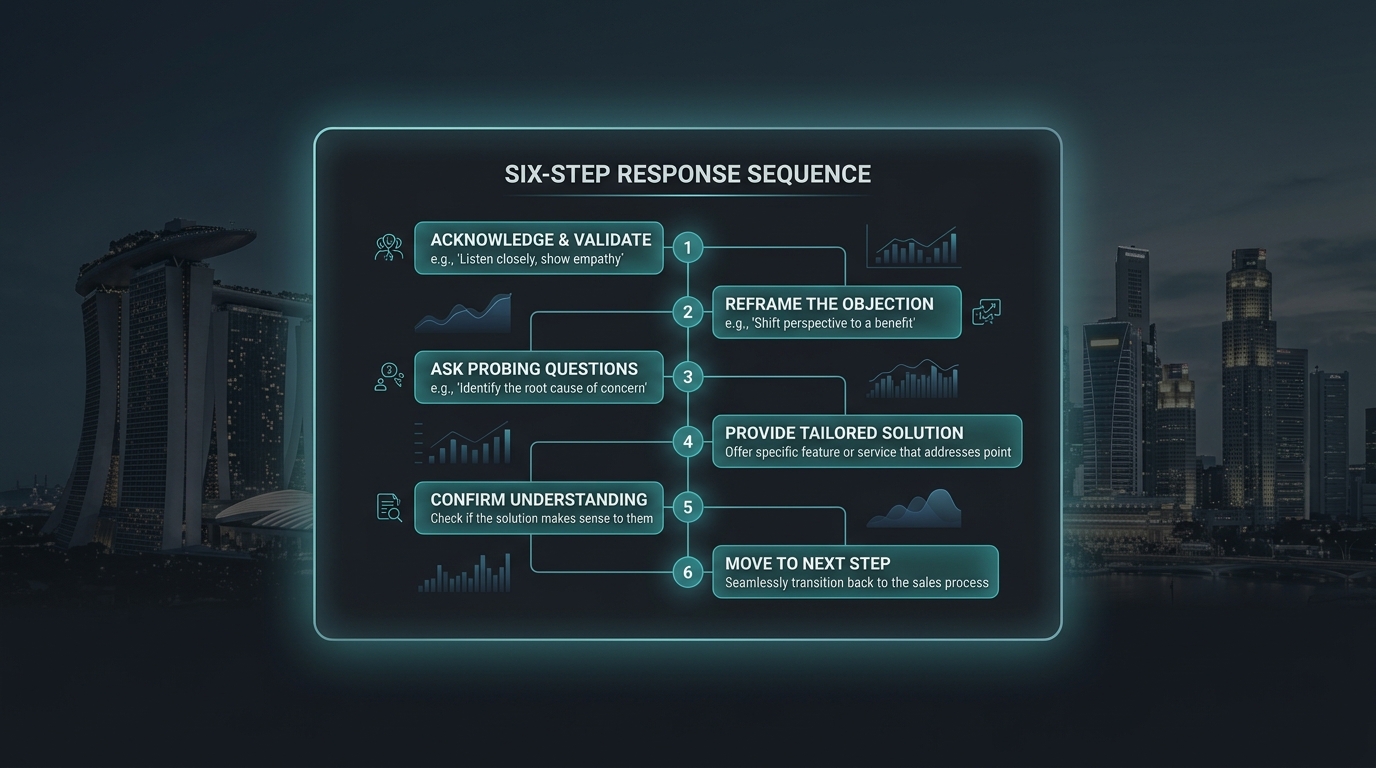
This rule exists because hotel buyers are sophisticated. They do not wait until the Implication stage to voice resistance. A GM who has been through dozens of vendor calls has a set of pre-loaded objections that fire early — sometimes as a genuine concern, sometimes as a test to see how the SDR handles friction. The SDR who treats the objection as an interruption to the planned arc will fumble it. The SDR who recognises it immediately and responds with a disciplined six-step sequence will turn most objections into the deepest point of the conversation.
There are thirteen objections that appear consistently across hotel SDR calls. Four are specific to hotel commercial operations. Nine cover the universal resistance patterns that every SDR encounters. All thirteen have the same response architecture: Clarify, Problem, Reframe, Implication, Need Payoff, Close. The sequence never changes. The specific language adapts to the objection and the market context.
The Four Hotel-Specific Objections
These four objections are unique to the hotel industry. Generic sales training does not prepare SDRs for them because they require domain knowledge to handle correctly.
Objection 1: "Our OTA already manages our pricing."
This is the most common domain-confusion objection in hotel SDR work. The GM or RM believes that the booking channel's rate management tool is equivalent to a dedicated revenue management approach. It is not — and the response must make that distinction without attacking a relationship the hotel values.
Clarify: "When you say the OTA manages your pricing — is it setting your rates based on your local demand picture, or is it distributing the rates you've already set?" That single question surfaces the distinction. The answer is almost always that the channel distributes. The clarification reframes the objection without confrontation.
Problem: "When the market moves and you need to respond — is the rate adjustment happening inside the OTA's tool, or does it go through your own review process first?" This establishes who is actually making the pricing decisions.
Reframe: "So the OTA is doing the distribution job really well. What we do is the step before that — deciding what rate to set, and when to change it, based on what the market is doing right now."
Implication: "When your comp set moves rates mid-week and your current process doesn't catch it until the next review — how many nights in that window are priced below where the market has already moved?"
Objection 2: "Our property management system already has a pricing module."
This objection is technically accurate — most modern property management systems include some form of rate management functionality. The question is not whether the functionality exists, but whether it is performing at the level the market demands.
Clarify: "Is the pricing module making automated recommendations based on live comp-set data, or is it more of a rate-calendar tool that the team updates manually?" Most SDRs are surprised to find that the GM often does not know the exact answer — which tells you everything about how actively the module is being used.
Problem: "When did the team last review how the module's recommendations compare to what your comp set is actually doing in real time?" This question surfaces whether the module is trusted and active or ignored and bypassed.
Objection 3: "We're too small — we only have 20 to 30 rooms."
This objection misunderstands the revenue opportunity calculation. A 25-room boutique property with a high ADR in a compressed market can represent a very significant annual revenue gap — sometimes more per room than a larger property in a softer market.
Clarify: "What's your current average rate for peak nights?" Then run the calculation: "If your comp set is running $40 above your peak rate for just ten nights a month across 25 rooms — that's $10,000 a month, $120,000 a year. Does that feel small?"
The Implication here is arithmetic, not abstract. Small properties respond to specific numbers more than any other buyer type because their margins are visible and their losses are personal.
Objection 4: "We tried revenue management software before and it didn't work."
This is the highest-trust objection in the set. The GM has already made a purchase decision, implemented something, been disappointed, and moved on. Arguing that this time will be different is the worst possible response.
Clarify: "Can I ask what didn't work about it? Was it the setup, the recommendations it was making, the team adoption, or something else?" The answer almost always reveals a specific failure mode — usually poor data quality, or a tool that required significant manual configuration to function.
Reframe: "The reason that matters is that what you're describing is one of the most common reasons properties come back to this conversation — not because the category is wrong for them, but because the first implementation had a specific gap." Name the gap they described. Then connect it to what is different about the current approach.
The GM who says "we tried it and it didn't work" is not saying no — they are telling you the exact thing you need to address before a yes becomes possible. That is the most useful objection on the list.
The Nine Core Objections — Pattern and Response
The nine core objections cover the universal resistance patterns that appear across every hotel market and every call type. They are grouped here by their underlying motivation.
The deflection group: "We already have a channel manager." / "Our revenue manager handles that." / "Send me more information first." These three objections share a structure — they route the conversation away from the SDR without technically rejecting the product. The response in all three cases is a clarifying question that opens the objection rather than closing it, followed by an Implication question that makes staying in the conversation more valuable than exiting it.
The timing group: "It's not the right time." / "We're in a busy period right now." These objections are often genuine — hotel teams do have genuinely busy periods. The correct response is not to override the timing concern but to reframe it: "Totally — can I ask, is the busy period creating more pricing pressure or less? Because that's usually when the gap between a manual review cycle and a live market response costs the most." Busy periods are precisely when the problem is most expensive. The timing objection is an Implication question waiting to happen.
The price group: "It's too expensive." / "We don't have the budget for this right now." Price objections in hotel sales almost always arrive before the prospect has calculated the cost of the status quo. The response is always to establish the revenue gap first — the specific dollar figure based on room count, market ADR, and the underpricing gap — before discussing the investment. A property leaving $120,000 a year on the table through suboptimal pricing does not have a budget problem. It has a calculation problem.
The competitor group: "We're looking at other options." This objection is the SDR's friend. It confirms the prospect is actively in a buying process, which is exactly the moment to accelerate — not to defend or compare features, but to anchor the conversation in the specific commercial outcome the prospect is trying to achieve. "What's most important to you in the evaluation — is it the quality of the market data, the speed of recommendation, or the ease of adoption for the team?" Whatever they name is the criteria to win on.
The Response Architecture That Works for All Thirteen
Every objection response follows the same six-step sequence. The language changes. The structure does not.
- Clarify: Ask a question that opens the objection rather than answers it. Never argue with the premise of the objection before you understand exactly what it means to this specific GM.
- Problem: Connect the objection to an operational gap. The OTA-pricing objection leads to a rate-review question. The "too small" objection leads to a revenue-gap calculation. Every objection has a Problem question hiding inside it.
- Reframe: Introduce the distinction that makes the objection workable. Not a counter-argument — a frame that gives the GM a different way to think about what they just said.
- Implication: Ask them to calculate the cost of the problem the objection just revealed. This is the step most SDRs skip when handling objections. It is also the step that turns a resistance moment into a buying moment.
- Need Payoff: Invite the GM to describe the benefit of solving it. Let them produce the value statement in their own words.
- Close: "That's exactly what I'd like to show you. It takes 20 minutes. Can we find a window this week?"
Why Objections Are the Most Valuable Data in the Call
Every objection a hotel GM raises is a piece of commercial intelligence. The GM who says "our OTA manages our pricing" is telling you they have conflated two different functions — and that clarifying that distinction will be the most valuable two minutes of their week. The GM who says "we tried it before and it didn't work" is telling you exactly what failure mode to avoid and exactly what success would need to look like for them to trust a second attempt.
The SDR who treats objections as obstacles to overcome will spend most of their career losing the conversation at the wrong moment. The SDR who treats every objection as the most revealing question the GM has asked all call will find that their pipeline looks different within a quarter. The data is in the objection. The deal is in the response.
The thirteen objections above are not exhaustive — hotel buyers will occasionally produce something novel. But in practice, more than ninety percent of all resistance on hotel SDR calls falls into one of these thirteen categories. Knowing the six-step response architecture for each one — cold, without hesitation, before the GM finishes the sentence — is the single highest-leverage skill in hotel outbound sales.
```