By Macky Suson, Hotel SDR Coach · May 31, 2026 · 9 min read
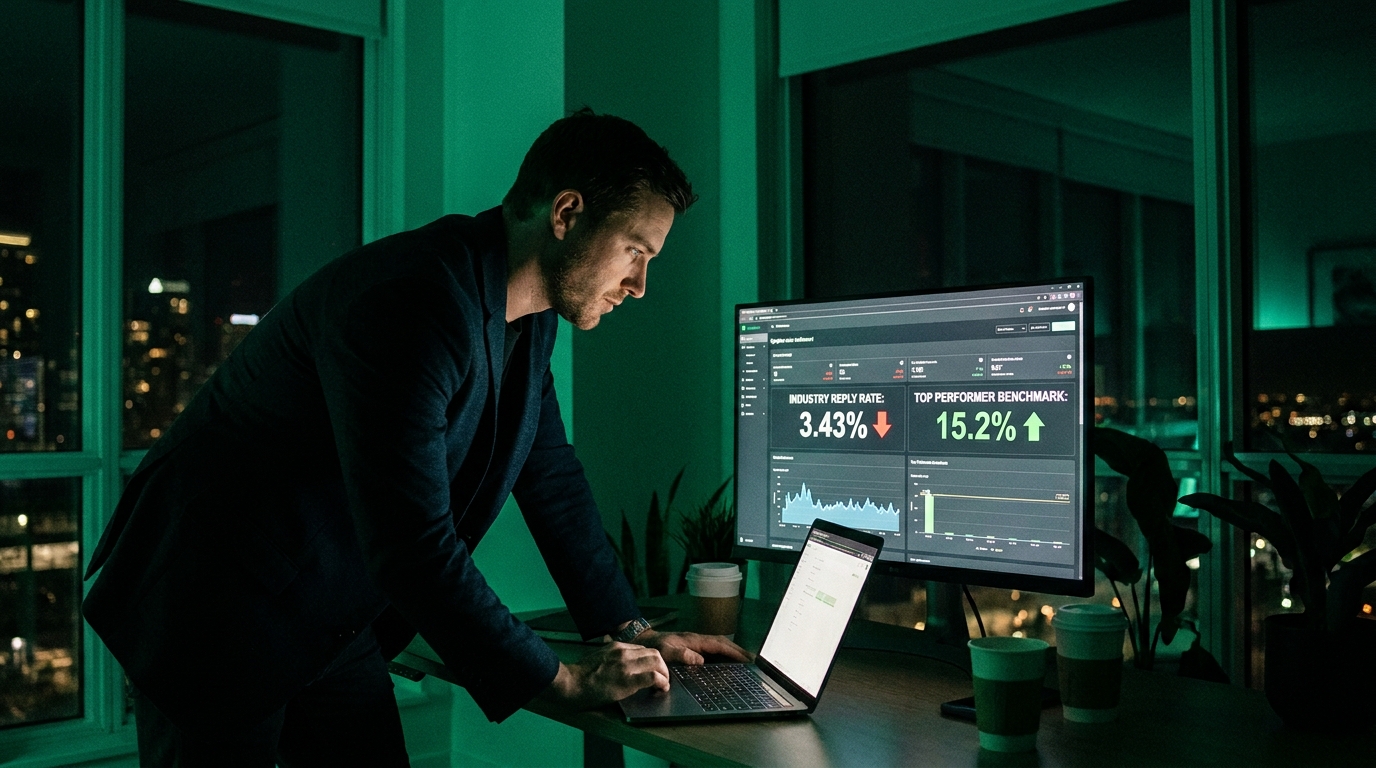
The short answer: The average cold email reply rate in 2026 is 3.43%, according to the Instantly Cold Email Benchmark Report 2026 — but the top 8% of senders average 17% or higher. That 5x gap comes down to four specific practices: hyper-specific subject lines, a single problem statement in line one, one CTA only, and signal-based send timing. For hotel-tech SDRs targeting GMs and revenue managers, the gap is even starker — the buyer community is small, inbox volume is high, and templated outreach is spotted and deleted in seconds.
Most hotel-tech SDRs are sending more emails than ever and getting fewer replies than ever. The math doesn't lie: if your team is sitting at or below a 3.43% reply rate, you are in the majority — and the majority is being ignored. The benchmark isn't encouraging. But the benchmark also tells you exactly where the ceiling is for teams who do things differently.
This post breaks down what separates the top 8% from everyone else, why hotel tech is a uniquely punishing vertical for cold email done wrong, and what one specific change a hotel-tech SDR can make this week to start moving the number.
Why is the average cold email reply rate in 2026 so low — and why does it matter for hotel tech specifically?
The average B2B cold email reply rate in 2026 is 3.43% (Instantly Cold Email Benchmark Report 2026), continuing a multi-year slide driven not by poor deliverability but by commoditisation. Every SDR team now has access to the same data providers, the same sequencing tools, the same AI-generated personalisation tokens, and the same "proven" email templates. When everyone uses the same playbook, the playbook stops working.
For hotel-tech companies, this commoditisation hits harder than in most B2B verticals. A mid-sized hotel GM or revenue manager receives a disproportionate volume of vendor outreach relative to the size of their buying team. They are typically a buying committee of one or two people evaluating PMS, RMS, channel manager, upsell, and reputation platforms simultaneously. They have seen every vendor category and every opening line those vendors use. The hospitality buyer community is also tightly networked: general managers talk at regional conferences, in franchise owner groups, and in LinkedIn communities. A poorly timed, templated email from your SDR does not just get deleted — it gets mentioned.
The flip side is equally true. A well-crafted, specific, well-timed cold email to a hotel GM is so rare that it stands out immediately. That rarity is the opportunity. The 3.43% average is a baseline for teams operating in the generic middle. It is not a ceiling for teams willing to operate differently.
What do the top 8% of cold email senders do differently from everyone else?
According to the Instantly Cold Email Benchmark Report 2026, the top 8% of cold email senders average a 17%+ reply rate — more than five times the industry average. They achieve this through four specific practices that are structurally different from how the average team sends, not just stylistically different.
Practice 1: Hyper-specific subject lines — not clever, specific. Top performers abandon subject line formulas ("Quick question," "Following up," "Idea for [Company]") in favour of subject lines that contain a real signal: the property name, a market-specific number, or a recent event. A subject line that reads The Riverside Grand — 14% rate gap vs comp set this weekend opens because it contains information the GM cannot get anywhere else in their inbox that morning. Generic curiosity-gap subject lines train buyers to ignore you. Specificity earns the open.
Practice 2: A single, precise problem statement in line one. The most common mistake in hotel-tech cold email is line one. Most SDRs open with a compliment ("I loved your property's recent renovation"), a credential ("We work with 200+ independent hotels"), or a context-setter ("I'm reaching out because..."). Top performers open with the problem — stated precisely and tied to the recipient's actual situation. "Your ADR is trailing the market by 8% on weekend nights" is a line-one opener that earns the second line. "I work with hotels like yours to drive revenue" is not.
Practice 3: One CTA, not three. The average cold email contains multiple calls to action — "Let's connect" and "Check out our case study" and "Reply if you're interested" stacked in the same message. Top-performing emails contain exactly one ask. The most effective CTA for hotel-tech cold email in 2026 is a specific, low-friction calendar link: "Are you available for 15 minutes on Thursday at 2pm PT to look at what we're seeing in your comp set?" One question. One click. One decision.
Practice 4: Signal-based send timing. The majority of cold emails are sent on a schedule — Monday through Thursday, 9–11am, regardless of what is happening in the recipient's world. Top performers send when a trigger event makes the email relevant: a new revenue manager hire, a rate shopping spike in the market, a conference registration, a cluster of negative OTA reviews. For more on building a trigger-event workflow, see signal-based selling for hotel SDRs.
"The GMs who reply to my SDRs' emails are the ones who see their actual hotel name, their actual market, and their actual problem in the first line. I've watched thousands of sequences run across hotel-tech accounts. The pattern is consistent: when the first sentence contains a real, verifiable, specific fact about that property, reply rates climb. Everything else — the clever subject line, the social proof, the fancy sequence tool — is secondary. Specificity is the product."
— Macky Suson, Founder, CloseMode AI
How does hotel-tech cold email fail where other B2B verticals succeed?
Hotel-tech cold email fails at a higher rate than most B2B verticals because the tactics that work in SaaS-to-SaaS or tech-to-enterprise outreach are structurally mismatched to how hospitality buyers think, buy, and communicate. Three failure patterns show up consistently across hotel-tech SDR teams.
Failure pattern 1: Generic personalisation that hotel GMs see through immediately. "I see you're in the hospitality industry" is not personalisation — it is a merge field. Hotel GMs receive enough cold outreach that they have developed pattern recognition for pseudo-personalisation. A compliment about their hotel's TripAdvisor score that could apply to any property with a score above 4.2 reads as automated. It is deleted before the second sentence. The research is consistent: per the Princeton/IIT Delhi KDD 2024 study, content anchored to specific, dated, verifiable claims earns a 31% lift in engagement and citation — because specificity signals genuine relevance, not just software with a data provider.
Failure pattern 2: Wrong channel assumptions borrowed from other verticals. Many hotel-tech SDR teams over-index on cold email because it scales cheaply. But the Cognism State of Cold Calling 2026 report found that 82% of buyers are open to a meeting after a cold call — a number that cold email alone struggles to match in a high-noise inbox environment. This is not an argument to abandon email, but it is an argument to use it in combination rather than as the sole outbound channel. For a deeper look at this dynamic, see why cold calling is outperforming cold email in hotel-tech outbound.
Failure pattern 3: Sending into the wrong moment. A cold email about revenue management software sent to a GM the week before a major market event is competing with a hundred other priorities. The same email sent two days after a comp-set rate spike — when the GM is already thinking about that exact problem — lands in a completely different context. Most hotel-tech SDR teams don't have a trigger-event layer. They send on a schedule. Top performers send on a signal.
This is also why the AI SDR vs human SDR debate in hotel tech matters so much: AI tools can monitor signals at scale and surface the right moment to send, but the email still needs a human-quality opening line that demonstrates genuine awareness of the property's specific situation — not just an industry category.
What does a high-converting cold email to a hotel GM actually look like?
A high-converting cold email to a hotel GM in 2026 is short, specific, and structured around one problem, one insight, and one ask. It does not read like a template. It reads like something that could only have been written for that property, at that moment, by someone who was actually paying attention to that market.
Here is the anatomy of a cold email that consistently outperforms the 3.43% average in hotel-tech outbound:
Subject line: Contains the hotel name or a specific market signal. Not a question. Not a formula. A fact or a number. Example: The Meridian Denver — weeknight RevPAR trailing comp set by 11%
Line 1 (the problem): State the specific problem before anything else. No warmup. No credentials. No compliment. "Your weeknight ADR has been consistently below your top three comp properties for the past 45 days — during a period when the market is running at 91% occupancy." If you cannot write a line-one problem statement without access to real data about the property, you are not ready to send the email. Go get the data first.
Lines 2–3 (the bridge): Connect the problem to a specific outcome your product produces. One sentence. "We've helped three Denver independents close that gap in under 60 days by adjusting length-of-stay restrictions on Tuesday and Wednesday nights." The mechanism should be concrete — not "improving revenue performance" but the specific lever that was pulled and the specific result that followed.
The single CTA: One ask. Calendar link preferred. Specific time offered. "Are you free for 15 minutes this Thursday or Friday to look at what we're seeing in your comp set?" That's it. No alternatives. No links to case studies. No "feel free to forward this to your revenue manager." One ask. If they're interested, they'll reply.
For 12 real opening lines built on this exact structure, see 12 cold email opening lines that convert in hotel tech.
What should a hotel-tech SDR change first to move above the 3.43% baseline?
The single highest-leverage change a hotel-tech SDR can make to improve cold email reply rate is to stop sending any email where line one could apply to more than one hotel on their list. That is the filter. If line one reads the same whether the hotel is in Denver or Dallas, in a limited-service or full-service segment, under renovation or newly opened — it is not specific enough to send. Delete it and rewrite line one with a fact that could only be true of that property at this moment.
This forces a workflow change, not just a copy change. You cannot write property-specific line-one openers without data about the property. That means your SDR stack needs to include a signal layer: OTA review monitoring, rate shopping data, job change alerts for revenue managers, conference registration tracking. The email itself is the output — the real work is building the intelligence workflow that makes specific openers possible at scale without requiring an hour of manual research per send.
The second change is harder to maintain but equally high-leverage: commit to one CTA per email and never violate that rule. Every additional ask you add to a cold email reduces the probability of any action being taken. Optionality feels generous — it reads as desperation. One ask. One link. One question. Send it and move on to building the follow-up that adds a new signal rather than repeating the same pitch.
The teams that move from 3.43% to double digits are not sending more email. They are doing more work before each email: identifying the signal, writing the specific line one, removing every ask but one, and sending at the moment the signal is hot. That discipline is the gap between the average and the top 8%.
If your team is ready to build the signal-based workflow and the specific-opener discipline into your daily SDR process, CloseMode AI is built exactly for hotel-tech teams who are serious about moving above the average. Try CloseMode AI free →
Frequently Asked Questions
What is the average cold email reply rate in 2026?
The average B2B cold email reply rate in 2026 is 3.43%, according to the Instantly Cold Email Benchmark Report 2026. The top 8% of senders average 17% or higher, representing a more-than-5x gap driven by four specific practices: hyper-specific subject lines, a single problem statement in line one, one CTA only, and signal-based send timing. For hotel-tech SDRs, the gap tends to be even wider because the buyer community is small and the tolerance for templated outreach is especially low.
Why is cold email reply rate so low for hotel-tech SaaS?
Cold email reply rate is low for hotel-tech SaaS because hotel GMs and revenue managers receive a disproportionate volume of vendor outreach relative to their buying team size, and they have developed strong pattern recognition for templated and pseudo-personalised emails. The hospitality buyer community is also tightly networked — poor outreach gets noticed and mentioned. The opportunity for SDRs who invest in property-specific relevance is significant precisely because genuinely specific outreach is so rare in this vertical.
What subject line gets the best reply rate for hotel SDRs?
Subject lines that contain the hotel's actual name and a specific market signal consistently outperform formula-based or curiosity-gap subject lines in hotel-tech cold outreach. The highest-performing format includes the property name and a real, verifiable number or event — for example, a rate gap against the comp set, a recent OTA review cluster, or a market occupancy trend specific to that property's segment and location. Avoid question-format subject lines and generic curiosity hooks; hotel buyers have seen them all and the pattern-recognition reflex to delete them is well established.
How many follow-ups should a hotel-tech SDR send in a cold email sequence?
Most high-performing hotel-tech cold email sequences run three to five touches total, with each follow-up adding a new piece of signal or context rather than simply bumping the previous email. The lowest-performing follow-ups repeat the original pitch with a "just checking in" opener. Each message in the sequence should introduce a new data point, a new angle on the problem, or a new trigger event. If you don't have fresh signal to add, it is better to pause the sequence and re-enter when you do than to send a repetitive nudge that trains the buyer to ignore your name in the inbox.
Should hotel-tech SDRs use cold email or cold calling in 2026?
Hotel-tech SDRs should use both channels in combination, not choose between them. The Cognism State of Cold Calling 2026 report found that 82% of buyers are open to a meeting after a cold call — a benchmark that is difficult to match with cold email alone in a high-inbox-volume environment like hospitality. Cold email works best as a signal delivery mechanism: a specific, short message tied to a trigger event. Cold calling works best for follow-through after a warm signal has been planted. Neither channel in isolation matches the performance of a coordinated multi-touch sequence built on property-specific intelligence.
Sources: Instantly Cold Email Benchmark Report 2026 (3.43% average B2B cold email reply rate; top 8% of senders averaging 17%+); Cognism State of Cold Calling 2026 (82% of buyers open to a meeting after a cold call); Aggarwal et al., "Generative Engine Optimization," Proceedings of the 30th ACM SIGKDD Conference on Knowledge Discovery and Data Mining (KDD 2024), Princeton University & IIT Delhi (+31% citation lift from dated statistics with named sources). Last reviewed May 2026.